
What Is the St Louis Jazz Festival?
The St Louis International Jazz Festival (Festival International de Jazz de Saint-Louis) has been running since 1992, making it one of Africa’s longest-running and most respected jazz festivals. It happens every May in the historic city of Saint-Louis, Senegal’s former capital, which sits on an island at the mouth of the Senegal River near the border with Mauritania.
The festival runs for about four days in late May. This year, it falls on May 13-17, 2026. During these days, musicians will arrive from all parts of Senegal, other African countries, Europe, the Caribbean, and the United States. As a result, performances pop up everywhere. You’ll find outdoor stages in public squares, intimate concerts in colonial courtyards, jam sessions in small clubs, and big headline shows on the main stage by the river.
It may sound like any other music festival, but what truly makes this one different is that it isn’t just about entertainment. The St Louis Jazz Festival was created with a specific mission. It was created to celebrate jazz as African heritage, to honor the music’s roots, and to create space for dialogue between African and diaspora musicians.
Why Saint-Louis? Why Jazz?
To understand why this festival exists and why it matters, you need to understand a bit about Saint-Louis itself.
Saint-Louis (called Ndar in Wolof) was the first French colonial settlement in West Africa and served as the capital of French West Africa until 1902. The city has this beautiful, slightly faded grandeur due to its colonial architecture with colorful balconies, narrow streets, horse-drawn carriages, and a laid-back island pace that feels completely different from the energy of Dakar.
The city is a UNESCO World Heritage Site because of its unique cultural and architectural significance. Historically, it has been a place where cultures mixed: the French colonizers, local Wolof and Fulani communities, African Americans who came as sailors or traders, Lebanese merchants, and later, artists and musicians from all over the world.
Jazz found a natural home here because Saint-Louis has always been a crossroads of all cultures. And the festival’s founders understood something important about jazz, its African DNA.
Characters specific to jazz, such as the rhythms, the improvisation, the call-and-response, and the blues scales, can be traced to African musical traditions that enslaved Africans carried to the Americas and transformed into new forms under unimaginable circumstances. Jazz is what happened when African rhythms met European instruments and the particular pain and resilience of the Black American experience.
The St Louis Jazz Festival was created to acknowledge and celebrate that connection. It’s a homecoming of sorts. A space where African and diaspora musicians come together, learn from each other, jam together, and recognize their shared musical ancestry.


What the St Louis Jazz Festival Feels Like
If you’ve been to music festivals before, especially big commercial ones, the St Louis Jazz Festival will feel refreshingly different.
First, it’s not overrun with tourists. Yes, there are international visitors, but the festival is primarily attended by Senegalese people, other West Africans, and serious jazz lovers from around the world who seek it out specifically. It feels more like a cultural celebration that you’re invited to witness and participate in than a tourist attraction.
Second, the festival is warm and communal. Performances happen in open-air venues where you’re sitting on plastic chairs or standing in squares alongside locals. People bring their families. Kids run around. Vendors sell food and drinks. Between sets, musicians mingle with the crowd. There’s no VIP section separating artists from audiences. Everyone’s in it together.
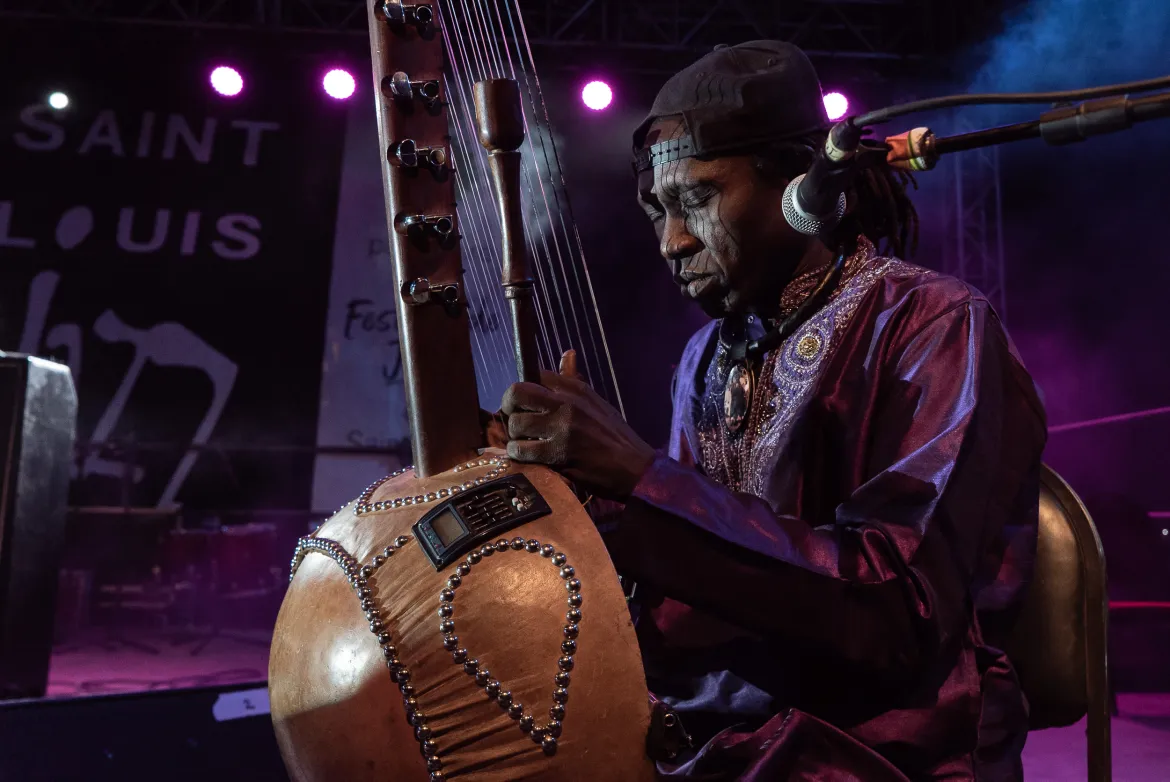
Third, the music itself is deeply varied. You’ll hear traditional African jazz that incorporates Senegalese mbalax rhythms, kora (the West African harp), and talking drums. You’ll hear American-style bebop and swing, Afro-Cuban jazz, Caribbean influences, and European experimental jazz. And if you’re lucky, a fusion from musicians from different continents who’ve just met backstage, jamming together and creating something entirely new in real time.
Why It Matters to Experience This
We could take you to Senegal any month of the year, and you’d have a beautiful time. You’d see the Pink Lake, explore Gorée Island, eat incredible food, experience Dakar’s energy, and come home with great memories. But being in Saint-Louis during the jazz festival adds a layer of cultural richness and emotional depth that you can’t get any other time.
You’ll understand something about African identity and diaspora connection that’s hard to grasp from reading or watching documentaries. Music carries history, preserves memory, and creates belonging across borders and generations.
Beyond that, you’ll experience Senegalese culture in a way that feels colorful, authentic, and contemporary, not frozen in time or performed for tourists. The festival showcases Senegal’s living culture, its musicians, its creativity, and its love for tradition.
And honestly, you’ll have an incredible time. Live music under the stars. The energy of talented musicians doing what they love. Dancing, good food, warm evenings by the river. Conversations with people from all over the world who are there for the same reason you are.
A Few Practical Things to Know
1. Weather in May:
Saint-Louis in May is warm but not unbearably hot (usually 25-30°C / 77-86°F). It’s before the rainy season starts, so you’ll have clear skies and comfortable evenings. Bring light, breathable clothing, a hat for sun protection, and comfortable walking shoes since you’ll be on your feet a lot.

2. Accommodation:
We’ll be staying at colonial-style guesthouses on the island of Saint-Louis. Last year on our trip to Senegal, we stayed at the lovely Au Fil Du Flueve and had one of the best experiences ever. The accommodations are charming and comfortable, and prioritize character over luxurious 5-star experiences. This is part of the experience. You’re in a UNESCO heritage city, staying in historic buildings, waking up to the sound of the call to prayer and the clatter of horse-drawn carts on cobblestone streets.
3. Language:
French and Wolof are the main languages in Saint-Louis. Many people in the tourism and music industries speak some English, but it’s helpful to know a few basic French phrases. We’ll have guides with us who can translate when needed.
4. Festival tickets:
Most outdoor performances are free. Ticketed concerts for big-name headliners usually cost $10-20 USD and can be purchased at the venue or sometimes in advance.
5. Safety:
Saint-Louis is a very safe, laid-back city. The festival atmosphere is relaxed and family-friendly. Standard travel precautions apply (don’t flash expensive items, be aware of your surroundings, keep your phone secure), but you’ll feel comfortable walking around during the day and evening.
Why We’re Excited About This
We’re heading to Senegal in May, and we’ve timed the trip specifically so we can experience the St Louis International Jazz Festival together with our Faraway Fam. If you’ve already signed up for the trip, you’re in for a treat. If you’re still deciding whether to join us, this might be exactly the reason you need.
Music has this way of breaking down barriers and creating instant community. You’ll find yourself dancing next to Senegalese families, chatting with French jazz lovers, sharing a drink with musicians from New Orleans, Havana, or Johannesburg, all brought together by a shared love of music and culture.
And when you come home, and someone asks, “How was Senegal?”, you won’t just talk about what you saw. You’ll talk about what you felt. The music. The energy.
Start Your Festival Playlist
If you want to start getting into the spirit of the festival, here are a few artists and albums to check out:
- Orchestra Baobab – Senegalese band with beautiful fusion of Cuban and Senegalese music
- Youssou N’Dour – Senegalese legend who has performed at the festival many times
- Herbie Hancock & African musicians collaborations – Shows the diaspora connection beautifully
- Cheikh Lô – Senegalese artist blending mbalax, jazz, and Afro-Cuban sounds
- Miles Davis or John Coltrane classics – To understand the American jazz lineage
Start listening now, and by May, the music will feel like an old friend welcoming you home.
Exploring Saint-Louis Beyond the Music
While the jazz festival is the main event, Saint-Louis itself is worth your attention. The city has a lot of character that exists whether there’s a festival happening or not, and some of your best memories might come from these quiet moments between performances.
1. You Have to Eat Thieboudienne (And Settle the Jollof Debate Once and For All)

Thieboudienne, or as it’s sometimes spelled, ceebu jën is Senegal’s national dish. It’s a fish and rice meal cooked in a rich, flavorful tomato sauce with vegetables. And here’s something that the jollof warriors may not like: this dish, which originated right here in Saint-Louis in the mid-1800s, is widely considered to be the ancestor of jollof rice.
Yes, that jollof rice. The one that Nigerians and Ghanaians have been arguing about for generations.
There’s an interesting story about the origin of the thieboudienne. It goes that a cook named Penda Mbaye, who worked for the French colonial governor in Saint-Louis, created thieboudienne by adapting local Wolof cooking methods with ingredients that were available at the time. She combined broken rice (which was cheaper and more accessible than whole grains), fresh fish from the Senegal River, tomatoes, vegetables, and spices into a one-pot dish that was filling, flavorful, and deeply satisfying.
From Saint-Louis, the dish spread throughout Senegal and across West Africa. As it traveled to Ghana, Nigeria, Sierra Leone, and Liberia, it evolved. The fish was sometimes replaced with chicken or meat. The vegetables changed based on what was local. The spices shifted according to regional preferences. And somewhere along the way, it became jollof rice as we know it today, with each country claiming their version is the best.
But the root of it all is here in Saint-Louis.
2. Art, Galleries, and the Creative Soul of Saint-Louis
Saint-Louis has always been a city of artists. The island’s beauty, its history, and its slower pace have drawn painters, sculptors, photographers, and writers for decades. During the jazz festival, this creative energy intensifies, but even outside festival season, the city’s art scene is abuzz and accessible.
There are several galleries and cultural centers worth visiting, many housed in beautifully restored colonial buildings. You’ll find contemporary Senegalese art, traditional textiles, photography exhibits documenting Saint-Louis’s history, and works by both established and emerging artists. Some galleries double as artist studios, so you might catch painters or sculptors at work.
Many galleries are concentrated in the old colonial quarter, so you can easily visit several in one afternoon while wandering the streets. Gallery owners and artists are usually happy to talk about their work, the city’s creative community, and how Saint-Louis continues to inspire new generations of Senegalese artists.
3. Walking Tours and Horse-Drawn Carriages
The best way to experience Saint-Louis is on foot or by calèche (horse-drawn carriage). The island is small enough to walk across in about 30 minutes, but you’ll want to take your time, stopping to look at buildings, peek into courtyards, and just soak in the atmosphere.
If you want more context and history as you explore, guided walking tours are available. Local guides (many of them historians or former teachers) will walk you through the colonial quarter, explaining the significance of different buildings, sharing stories about Saint-Louis’s role in French West Africa, and pointing out details you’d miss on your own. These tours usually last 1.5-2 hours and give you a much richer understanding of the city.
The other option, and honestly, one of the most charming ways to see Saint-Louis, is to hire a calèche for an hour or two. These horse-drawn carriages have been part of Saint-Louis’s identity for over a century. The drivers know the city intimately and will take you through the main streets and quieter back lanes, stopping at viewpoints and explaining what you’re seeing as you go.
You can find calèches near the Faidherbe Bridge or in the main squares. Prices are negotiable (expect to pay around $15-20 for an hour), and drivers are used to tourists, so they’ll understand if your French is limited.


4. The Faidherbe Bridge and Langue de Barbarie
No visit to Saint-Louis is complete without crossing the Faidherbe Bridge and spending time on the Langue de Barbarie.
The Faidherbe Bridge is an iconic iron bridge designed by Gustave Eiffel (yes, the same Eiffel who built the tower in Paris) and completed in 1897. It connects the island of Saint-Louis to the mainland and is a beautiful piece of engineering, especially at sunset when the light turns everything golden.
You can walk across the bridge (it takes about 10 minutes) and watch fishermen below, pirogues gliding along the river, and pelicans diving for fish. It’s one of those spots where you’ll inevitably stop to take photos because the views are just that good.
Once you cross the bridge, you can take a pirogue (traditional wooden boat) to the Langue de Barbarie, a thin strip of land that separates the Senegal River from the Atlantic Ocean. This area is part of the Langue de Barbarie National Park, a protected reserve known for birdwatching (pelicans, flamingos, herons) and its fishing villages.
Pirogue trips are easy to arrange. You’ll find boatmen near the river offering rides. The trip across takes about 10-15 minutes, and you can negotiate to have them wait for you and bring you back, or you can arrange a pick-up time.
This Is Your Invitation
Saint Louis is a place worth exploring for its music and its cultural and historical significance. Don’t be the person who has to hear about the experience from others when you can see it all firsthand.
We still have a few slots open for our upcoming trip to Senegal. Once they’re filled, that’s it. And the next St Louis Jazz Festival is a full year away in 2027.
Leave a Reply